
Speak or Swim?
What Your Brain Does When You're Thrown into the Spotlight!
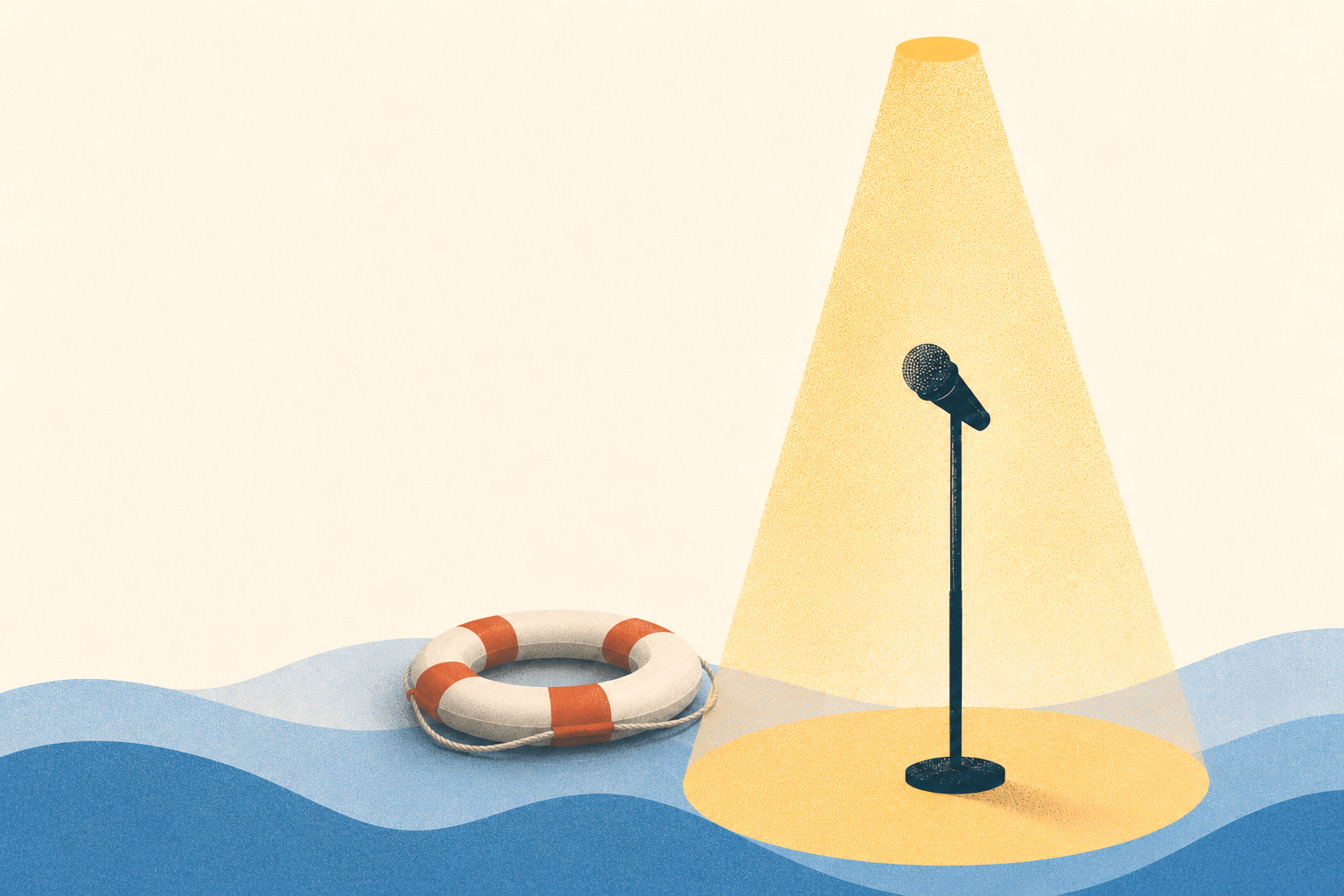
In a recent one-on-one session, a client described a pattern her director had established. Without any warning, he would pull her aside and say, "You're presenting in ten minutes." The logic was straightforward: sudden exposure would supposedly force her to overcome her fear of speaking, like throwing someone into deep water to make them swim.
It sounds bold. But does it actually work? The science behind this is a bit complex, and I have done my best to keep it short. Bear with me, because understanding what happens in the brain is what makes the practical steps at the end of this article more than just tips. It makes them make sense.
The Chain of Fear
When someone is plunged into an unexpected, high-stakes situation, the body reacts immediately. The limbic system fires first. The amygdala, acting as the brain's rapid alarm system, detects threats and drives the fight-or-flight response. Stress hormones flood in. The heart races. Attention narrows. And critically, the memory for that moment becomes embedded with unusual strength.
For those who want a better understanding of the science, glucocorticoids and adrenaline are released during acute stress, directly enhancing the consolidation of fear-based memories in the amygdala. Roozendaal, McEwen, and Chattarji (2009) describe the amygdala as a central hub for integrating stress hormones and emotionally enhanced memory, a finding supported and extended by Bhatt et al. (2016) at the molecular level. The brain does not simply record the event. It amplifies it.
What happens then? The experience meant to "correct" the fear may instead be encoded as a highly aversive memory: "When I don't know what's coming, I get thrown into the spotlight and feel powerless." That embeds. And once it does, it is durable.
When Stress Rewrites the Brain
The amygdala does not work alone. It interacts with the hippocampus, which gives context to memories, and the ventromedial prefrontal cortex, which helps us calm down and manage fear. When someone faces repeated, unexpected stress without support, these calming systems don't get a chance to help function. The result is a powerful fear memory and a feeling of lost control.
Research shows this effect can last. Lange et al. (2022) found that high-stress fear conditioning makes it much harder for the brain to unlearn fear, sometimes for days. The fear memory becomes stronger, and recovery is more difficult. Stress doesn't just create fear; it makes it stick.
Other studies find that trauma rapidly alters how the brain's networks function, especially those involved in threat detection and self-control (Shvil et al., 2021). This isn't just a bad moment—it can reshape the brain's system for handling stress
"Overcoming Fear" Backfires
We have been wired to believe that pushing someone into a hard situation is for their own good. It's part of our collective unconscious, echoed in old-school parenting advice and the way many of us were taught to build resilience. The intention is often genuine: if you survive this, you will be stronger. But without scaffolding, clarity, and the chance to reflect, something else gets encoded. Not "I rose to the challenge," but "I was frightened." Not "I am capable," but "I am exposed."
Neuroscience is consistent on this point. Simply being confronted with a threat is not enough to rewire fear into confidence. Craske et al. (2014) showed that effective exposure therapy depends on controlled conditions, a sense of safety, and the gradual building of mastery. When those conditions are absent, the exposure does not extinguish fear. It can reinforce it. It resembles the moment of throwing someone in deep water, who doesn’t know how to swim without any swimming gear.
The Science of a Better Approach
If we accept that the brain does not automatically convert stress and challenge into growth, then as leaders we need to ask a harder question. Are we setting up difficult situations with care, or are we simply creating more threat memories?
The evidence points toward four practices worth building into how we develop people.
Signal and Prepare. Let people know what’s coming. Anticipated challenges activate the brain’s planning centers and make tasks feel manageable.
Support and Reflect. Afterward, discuss what happened. Reflection helps the nervous system process the experience and close the memory loop.
Gradual Exposure and Mastery. Build confidence through repeated, progressively harder tasks—not sudden, high-pressure moments.
Integration and Meaning. Explain the purpose behind challenges and allow reflection after the experience. When people understand the meaning, experiences become growth.
Final Thoughts
At Speakout, we work with individuals and organizations on exactly this intersection: the space between challenge and support, between high expectations and genuine development.
The most effective leaders are not those who simply demand performance. They are those who create the conditions in which performance becomes possible because they know that fear that goes unprocessed does not dissolve. It compounds.
Further Reading & References
Roozendaal, B., McEwen, B.S., & Chattarji, S. (2009). Stress, memory and the amygdala. Nature Reviews Neuroscience, 10, 423–433.
Bhatt, S. et al. (2016). Molecular Mechanisms of Stress-Induced Increases in Fear Memory Consolidation within the Amygdala. Frontiers in Behavioral Neuroscience, 10, 191.
Zhou, M. et al. (2018). Glucocorticoid receptor-mediated amygdalar metaplasticity underlies adaptive modulation of fear memory by stress. eLife, 7, e34135.
Lange, I. et al. (2022). Unrelenting Fear Under Stress: Neural Circuits and Mechanisms for the Immediate Extinction Deficit. Frontiers in Systems Neuroscience, 16.
Giustino, T.F. & Maren, S. (2015). A translational perspective on neural circuits of fear extinction. Neurobiology of Stress, 4, 1–12.
Shvil, E. et al. (2021). Experimental trauma rapidly modifies functional connectivity. Brain Imaging and Behavior.
Craske, M.G. et al. (2014). Enhancing Exposure Therapy for Anxiety Disorders, OCD, and PTSD. Journal of Anxiety Disorders, 35, 192–212.